

The complete guide
How to Choose a Cat Tent and Tunnel for Safe Outdoor Time
The window-watching problem
Most indoor cats are not bored of their home. They are bored of the glass. You can see it in the way they sit at the same windowsill every morning, ears swivelling, tail flicking at a bird they will never reach. The air they breathe is the air you breathe, filtered through a closed house, every single day.
The obvious fix is to let them out. For most owners that is not an option. There are roads, dogs, neighbouring cats, ticks, and the quiet maths of how many cats never come home. Outdoor access also puts a lot of pressure on local wildlife, which is reason enough on its own in plenty of neighbourhoods.
So you end up stuck between two bad choices. Keep the cat inside and accept the window-staring, or let them roam and accept the risk.
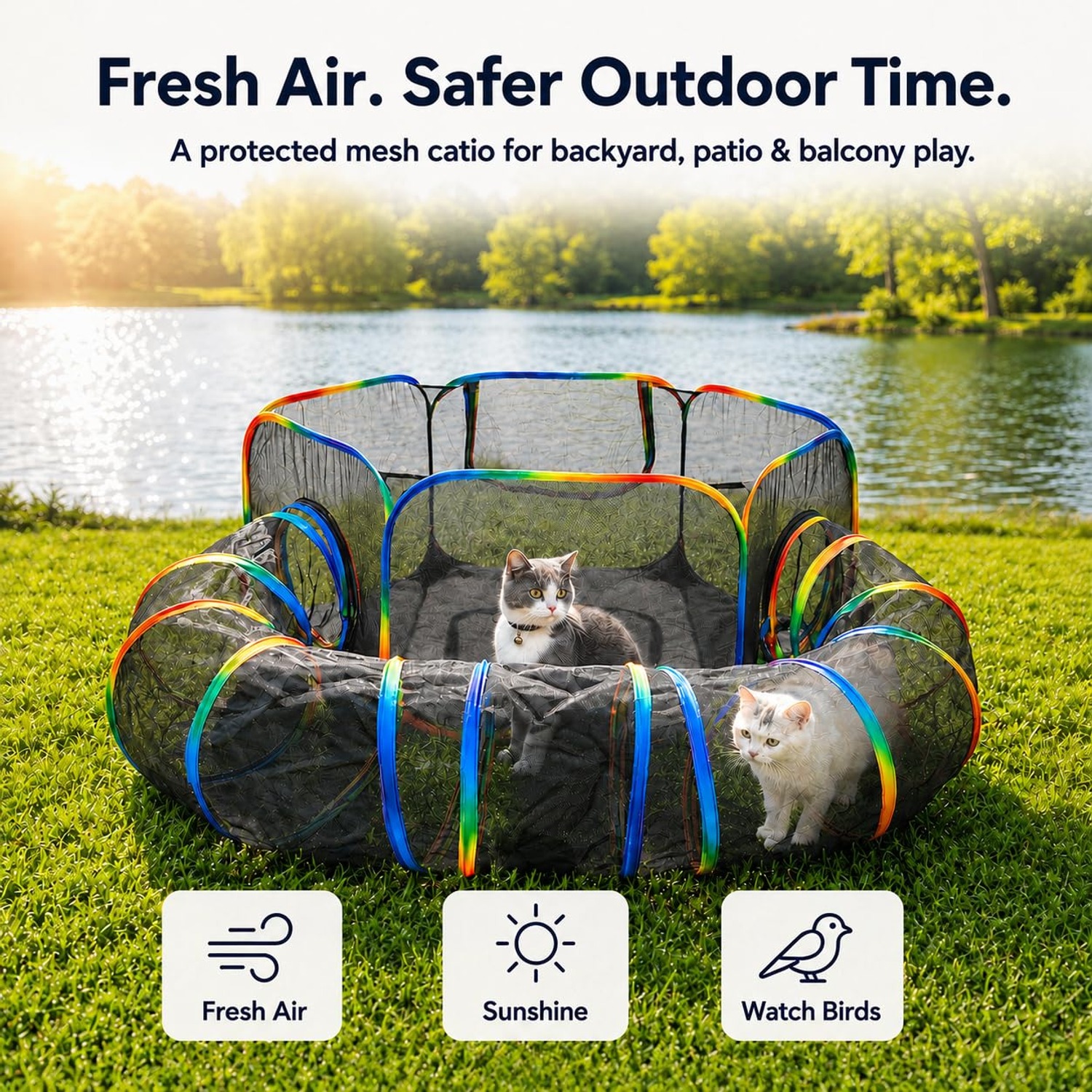
A cat tent and tunnel is the third option. It is a zipped mesh space you set up on the lawn, the deck, or the balcony, and your cat gets real grass, real smells, and a real breeze inside a boundary you control. Nobody has to modify a fence. Nobody has to train a walking lead. You unzip it, your cat walks in, and you both sit outside for an hour.
How this setup actually works
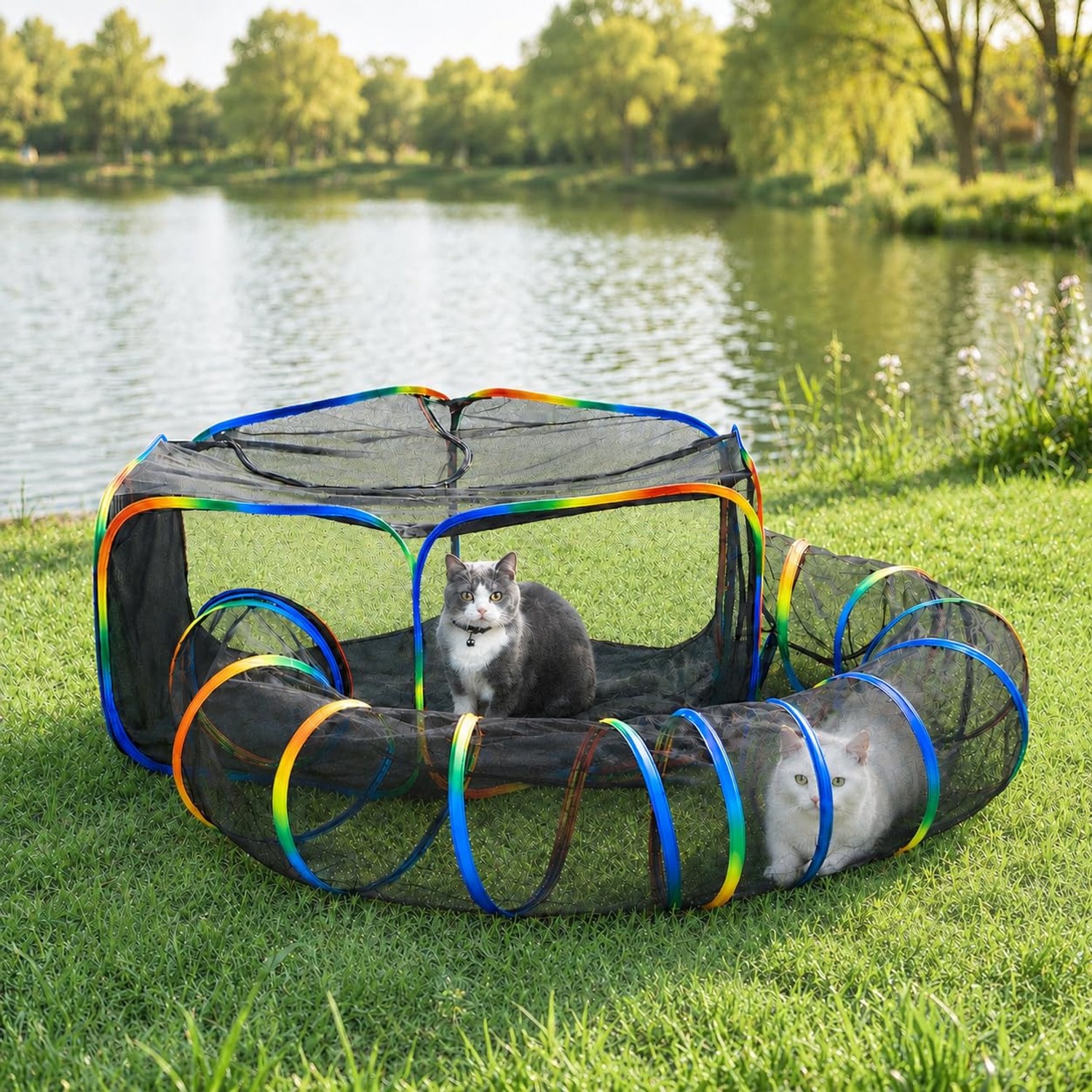
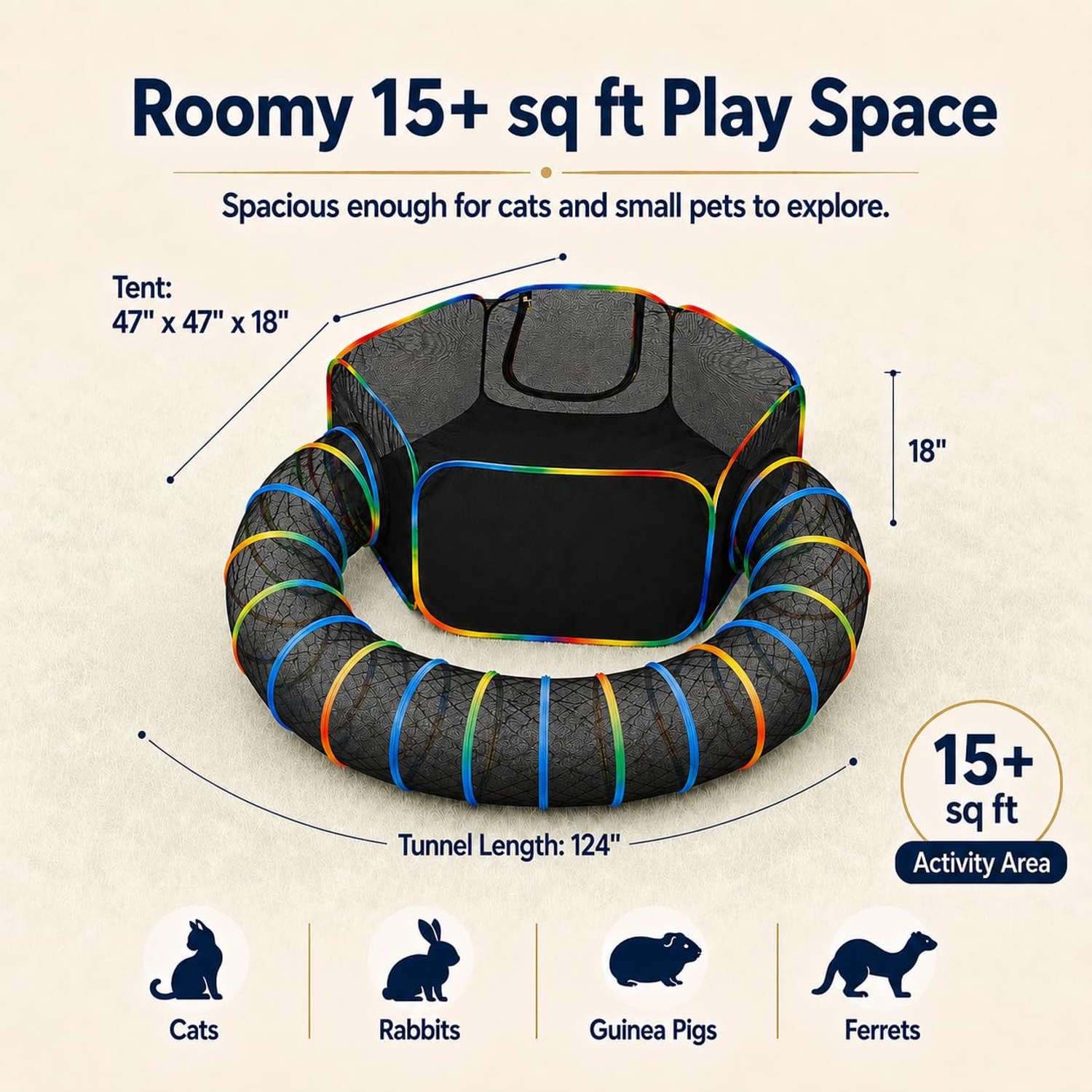
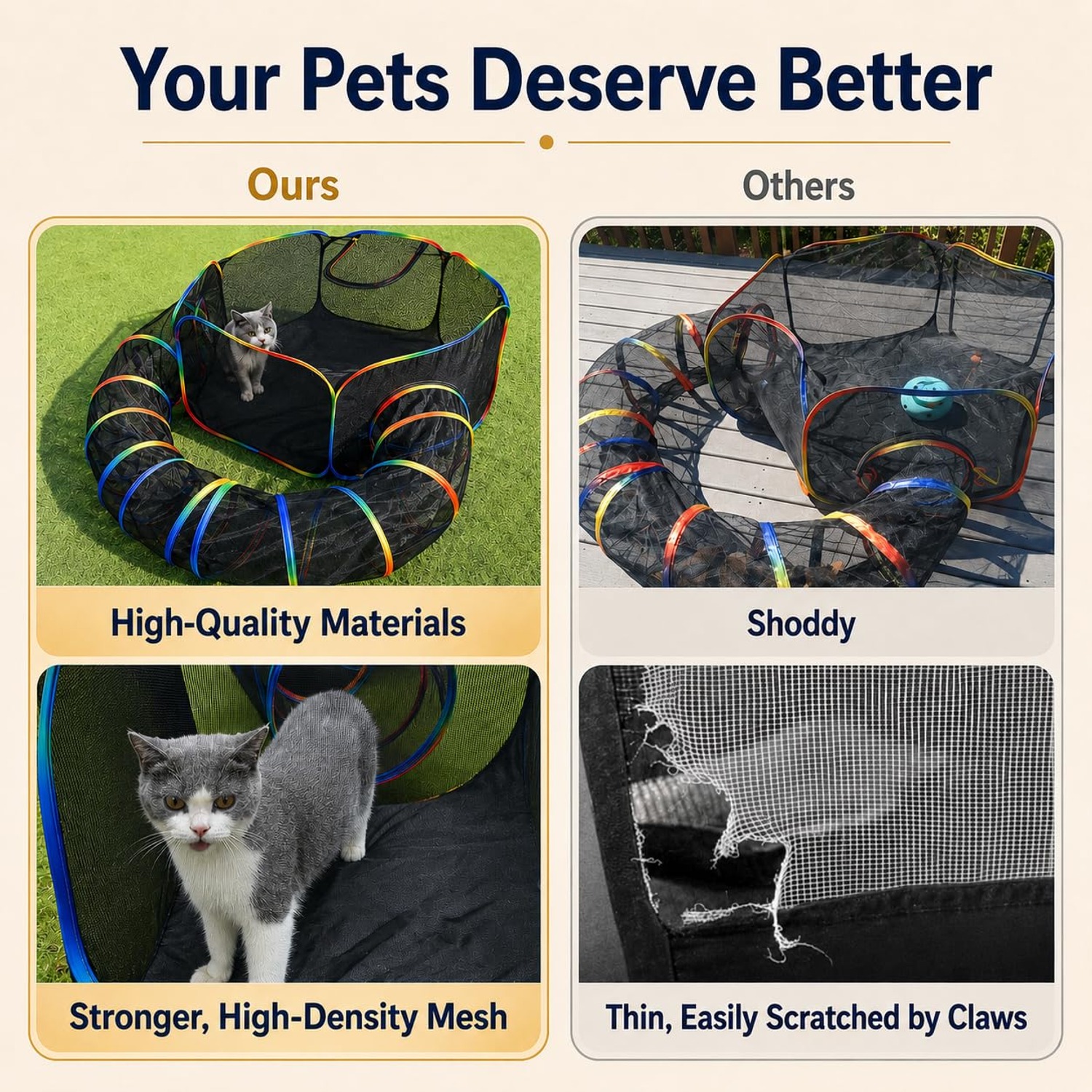
This one comes in two pieces. The hexagonal tent is the main space, with mesh panels for airflow and two large zipper doors. The tunnel is a long connecting run that zips onto the tent.
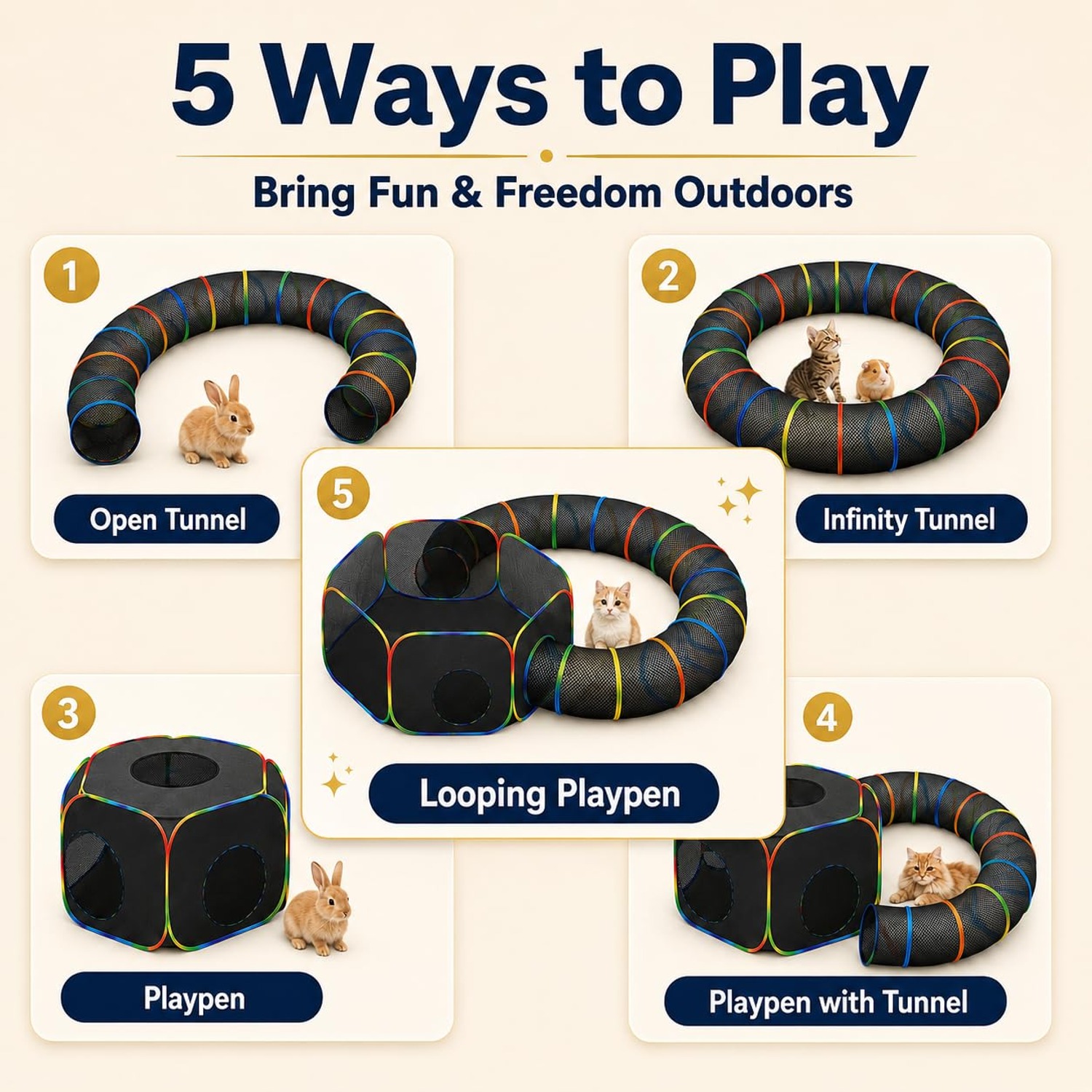
Together they make a circuit. A cat sits in the tent, spots something, bolts down the tunnel, turns, and bolts back. That loop is the difference between a cat that lies down for ten minutes and a cat that actually plays. A plain box encourages sitting. A tunnel encourages movement.
The pieces also work apart. The tent alone is enough on a small balcony where a full outdoor cat playpen simply will not fit. The tunnel alone is a great indoor toy on a rainy day, rolled out down a hallway where your cat can ambush you as you walk past.
Mesh is doing most of the quiet work here. Airflow matters because a cat in an enclosed fabric space on a warm day heats up fast. Visibility matters just as much. Cats settle when they can see what is around them. Put a cat in a solid-walled box and the first thing they do is look for the exit. Put them in a mesh cat enclosure and they lie down and watch.
Both pieces fold flat into the included storage bag. That is the practical bit people underrate. A built catio is excellent and also permanent, expensive, and impossible if you rent. A foldable cat tent lives in a cupboard and goes in the car.
Who it suits
It suits indoor-only cats best. These are the cats getting the most out of it, because the difference between zero outdoor time and an hour on the grass is enormous for them.
It suits apartment owners. A balcony catio is one of the few ways to give a high-rise cat outdoor air safely, and a pop-up version means you are not drilling anything into a rental.
It suits people with a yard but no cat-proof fence. Fence rollers and full enclosures cost real money and take a weekend. A tent costs less and takes two minutes.
It suits travellers and campers, because your cat gets a familiar space in an unfamiliar place.
It suits elderly or recovering cats who want sun and sniffing without the energy for a walk.
Who it does not suit is just as important. A cat that panics in confined spaces should not be zipped into anything. A cat that has never been outside may need weeks of slow introduction and might still refuse, and that is their call to make. And if you want something a cat can be left in alone for an afternoon, this is not that product. Mesh and zips are for supervised sessions.
Choosing well
Start with your space. Measure the patch of lawn, the deck section, or the balcony floor you plan to use, and be honest about it. A tunnel attached to a tent needs a straight run. If you only have a two-metre balcony, plan on using the tent by itself.
Think about your cat's temperament, not their size. A calm cat who already enjoys a carrier will walk straight in. A reactive cat needs the tent set up indoors for a week first, doors open, with a blanket that smells like home inside. Treats help. Forcing never does.
Check the door situation. Two large zipper doors matter more than you expect. A single small opening means an awkward crouch and a half-lift every time, and that is exactly when a nervous cat squirms free. Two doors mean one for entry and one for reaching in with water, a toy, or a hand.
Look at how it packs. A cat tent with storage bag is a different product from one that folds into an untidy armful. If it does not pack cleanly it will live in the garage, get dirty, and never get used.
Consider the number of cats. Two cats who already get on will share, especially with the tunnel giving them a second zone. Two cats who bicker indoors will bicker here. Run separate sessions in that case.
Using it safely
A few habits make all the difference.
Pick calm weather. Light mesh structures lift in wind. On a breezy day, peg the base down or weight it with something flat and heavy, and if the wind strengthens, pack up.
Watch the sun. Mesh lets light straight through, so it provides airflow, not shade. Set up under a tree, an awning, or a shade sail, put a water bowl inside, and avoid the middle of the day in summer. Cats hide heat stress well, and by the time it shows it is already a problem.
Stay present. Supervision is not a legal disclaimer, it is the actual design brief for a portable cat run. Zips can be nosed, seams can be clawed, and a cat left alone long enough will eventually test both.
Check the ground first. Look for bees in clover, ant trails, sharp sticks, and anything that has been sprayed recently. A towel or washable mat inside keeps paws off damp grass and gives a more inviting surface.
Keep sessions short at first. Ten minutes is plenty for a first outing. Build up as your cat relaxes.
Looking after it
Care is simple and it extends the life of the thing considerably.
Shake out fur, grass and grit after every session. Spot clean the mesh and fabric with warm water and a mild pet-safe detergent, then let it air dry fully before folding. Do not machine wash, do not tumble dry, do not bleach.
The zips deserve attention. They are the part that fails first on any pop-up catio, and the usual culprit is grit in the teeth. Brush them clean and never force a stuck slider.
Dry it completely before it goes in the bag. Packing damp fabric away is how you get mildew spots and that unmistakable musty smell. Store the bag somewhere dry and out of direct sun, because UV weakens fabric over time even when the tent is folded.
A note on the listed dimensions
The manufacturer's record for this item lists a product dimension of 25 x 25 x 25 millimetres. That is plainly a data entry error in the supplier feed, since no tent is 25 millimetres across. Rather than guess at the real number, we have left the dimensions field blank on this page. If the exact footprint is a deal-breaker for your balcony or deck, get in touch before ordering and we will confirm what we can.
Likewise, weight and country of origin are not specified in this record, so we have not stated them. We would rather leave a field empty than fill it with a plausible-looking number.
The short version
An indoor cat does not need a whole garden. They need an hour on the grass with their person nearby. A cat tent and tunnel gives you that without a fence project, a walking lead battle, or a permanent build.
This set is two pieces that zip together or work alone, made of polyester with mesh panels, with two large zipper doors and a bag to pack it into. Assembly takes minutes. Storage takes none.
Use it on calm days, in shade, with you nearby, and treat it as supervised time rather than a holding pen. Do that and it becomes the part of the week your cat waits for.